Modekal
Performance genetics for athletes. Your DNA first, then everything your watch knows—read on your own phone.
Know Before It Breaks
Most people find out how their body works after it breaks. Training and nutrition are designed for an average person who doesn’t exist, and medicine waits until something goes wrong. The signals to know sooner are already there—in your DNA, your wearable, and your biomarkers—but they live in separate places, and no one connects them into a plan that changes as you do.
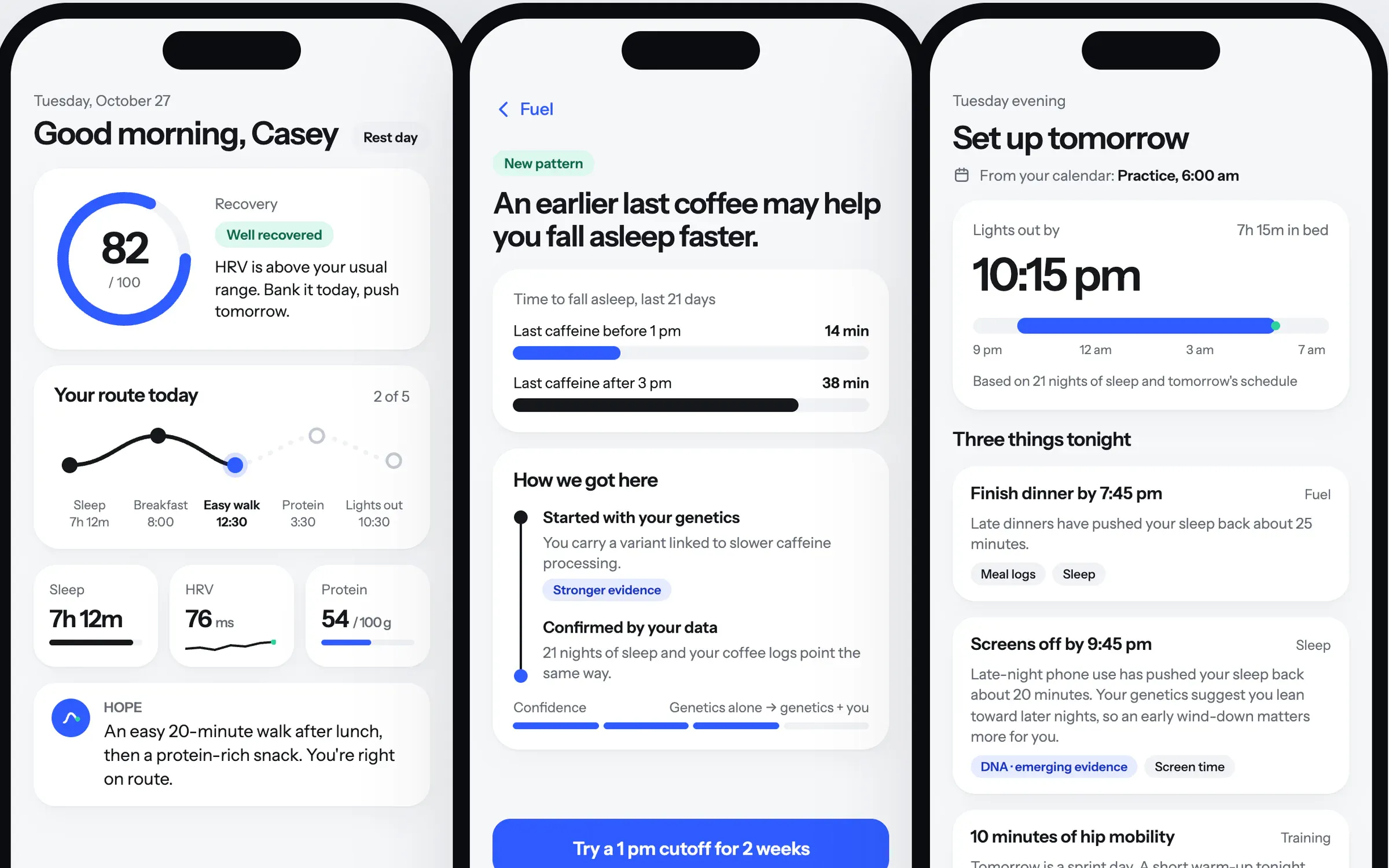
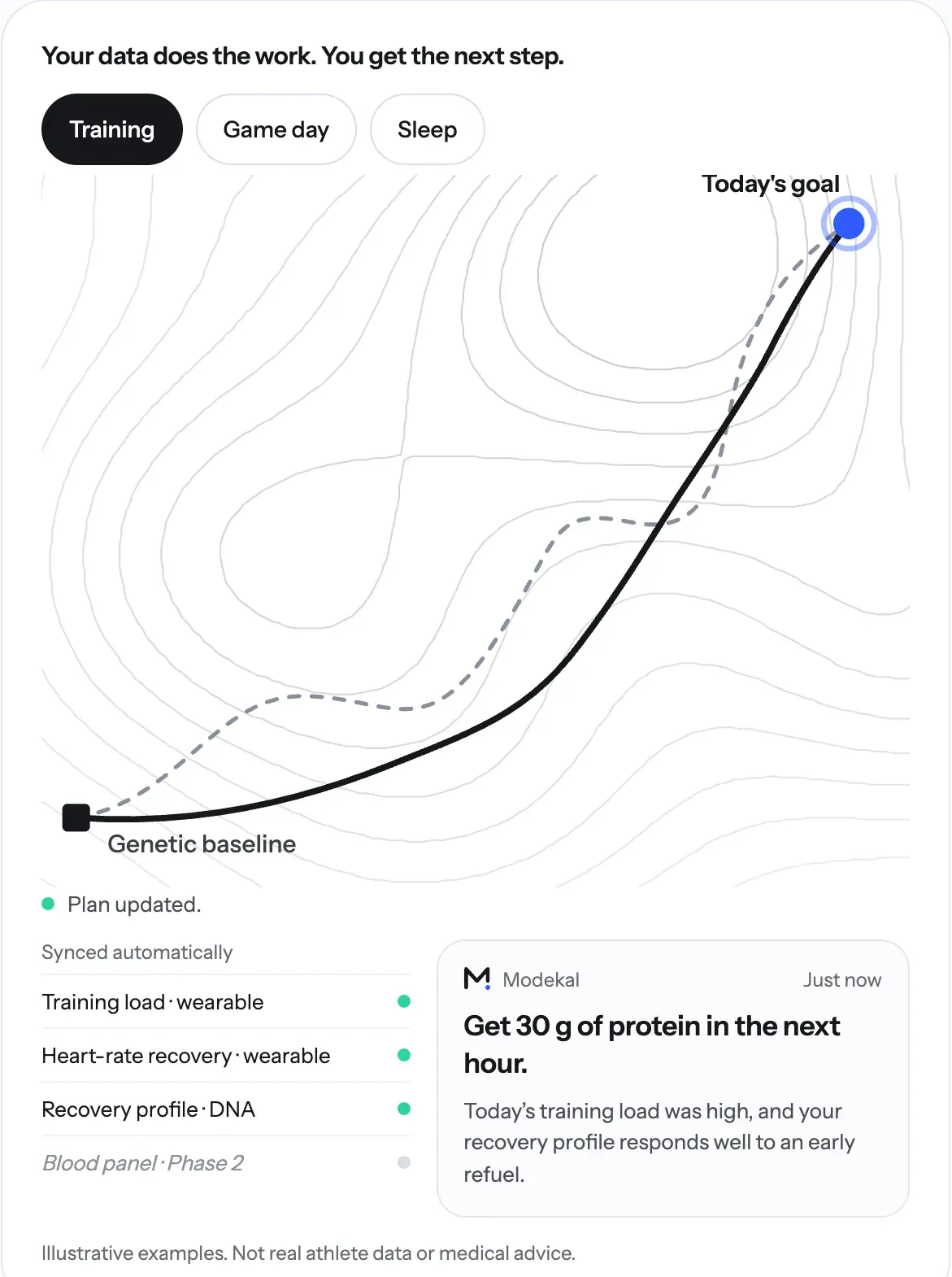
Modekal does. It starts with an athlete’s DNA to build a baseline, then layers in what the body is doing right now, from the wearable, daily check-ins, and test results, and reads each new piece against that profile. The result isn’t a report. It’s a route.
Your tracker is the dashboard. Your DNA tells you what you’re driving.
How It Works
- Map the starting point, once. A single genetic test captures how the athlete’s body is built to perform. Everything after is measured against it.
- Read the signals, every day. Four inputs arrive continuously: short daily check-ins the athlete completes, whatever wearable they already wear, health testing entered by hand or pulled in wherever an API exists, and notes from coaches and performance staff.
- Guide the next move, throughout the day. Short, plain-language prompts on training, nutrition, recovery, and sleep—first thing in the morning, after a workout, before a game.
- Re-tune the route, every month. The body takes three to six weeks to adapt to a change, so the plan is reviewed monthly, not weekly, around how the athlete has actually responded.
What I Built
I built Modekal’s app, its server, and its cryptography: one codebase that runs as an iPhone app and in a browser. Before any of it, though, came one rule, and everything else follows from it.
National dietary guidance is strong. Nutrigenetic evidence is weak.
So the cited eating pattern sets the route—the same route for every athlete—and a genome may only add a note beside a step. It never invents, removes, reorders, or puts a number on one. What differs from one athlete to the next is the day plan: the carbohydrate and protein that published sports nutrition guidance gives for the kind of day a team has, turned into grams by the athlete’s own body weight, on their own phone. Someone who never adds a DNA file still gets the whole product.
- DNA, read and let go. An athlete adds a raw file from AncestryDNA or 23andMe. It holds about 700,000 sites; Modekal reads 14 of them on the phone, keeps about a kilobyte, and lets the file go. It is never uploaded and never stored.
- Scores for a doctor, not a coach. On the device, Modekal can rank an athlete on 32 published polygenic scores, against the 2,504 reference genomes of the 1000 Genomes Project. The reference packs ship with the app, so a phone scores with no network. A result only ever goes, sealed, to a team doctor the athlete chose, and only on a demo team until clinicians sign off on the rules.
- Who sees what. Athletes, team doctors, coaches, and admins each see a different slice. A coach decides who plays, and a team is often an athlete’s employer, so a coach never sees anything genetic. That rule lives in one permission check, enforced by the server and asserted when the module loads: widen it, and nothing starts.
- When something needs a doctor. The athlete picks a team doctor and a term of 1, 3, 6, or 12 months. Their own phone does the noticing, against rules that only a clinician can sign off; each note travels sealed to that doctor and nobody else; and the doctor decides what the athlete is told, in their own words. Until then, the athlete’s screen says only “With your doctor.”
- Apple Health, a day at a time. My own read-only HealthKit bridge, in Swift, asks for one total or one average a day. No single heartbeat, no location, and no time of day reaches the app. Every reading is compared with the athlete’s own history, beside just two cited figures: 150 active minutes a week and 7 hours of sleep a night. There is no readiness score, and no verdict.
- Native where it counts. The tab bar, confirmation sheets, and haptics are real UIKit, so on iOS 26 they are Liquid Glass because the system makes them so. Home-screen widgets and meal reminders run on the phone itself, and since both show on a lock screen, neither ever carries a DNA note or anything about a doctor. On a laptop, the same app opens as a desk, linked to the athlete’s iPhone by a code and six digits.
- A lint for health claims. One command runs the data gate, a lint that checks no user-facing string makes a health claim, every typecheck, more than 130 test files, and a production build.
Your DNA Never Has to Leave Your Hands
You can change a password. You can’t change your DNA. Privacy and security architecture is my lane on the founding team, so I built Modekal’s vault in Rust, compiled to WebAssembly.
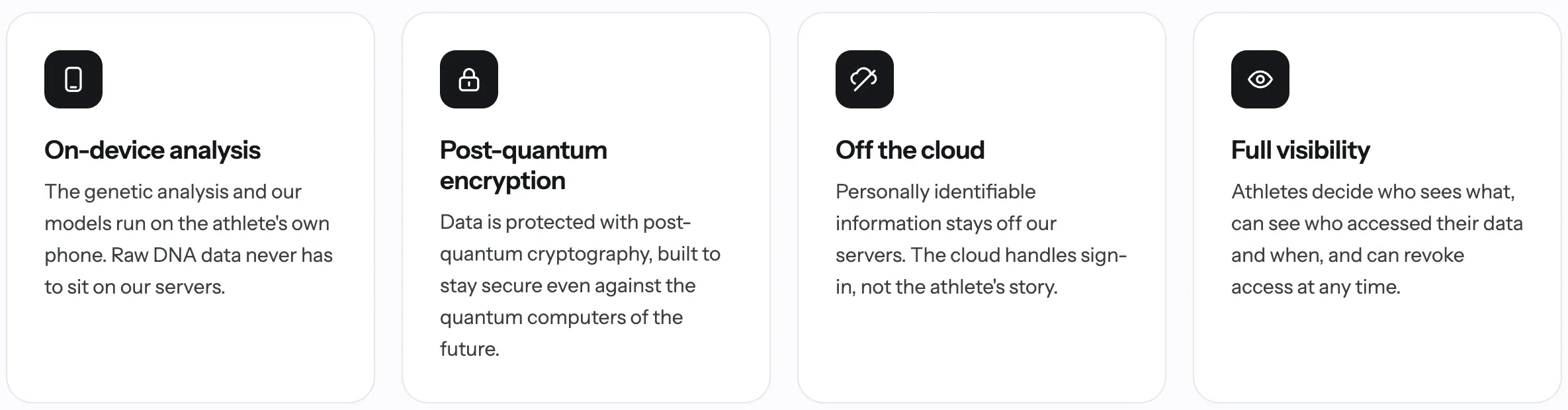
A record is sealed where it is created, under a fresh key, and padded to a fixed size so even its length gives nothing away. That key is wrapped to the owner’s own ML-KEM-1024 key, derived from 24 words and nothing else. Sharing a record with a doctor means re-wrapping one key to one person and signing the grant with ML-DSA-87, which the server can verify without being able to open the record. Every primitive is a NIST standard—AES-256-GCM, HKDF-SHA-512, SHA3-256—and no classical public-key algorithm is compiled in at all. Each step lands on an append-only, hash-linked ledger that carries fingerprints and nothing else.
When a doctor’s term ends, access ends by itself, in the server’s policy and in the wrapped key. When an athlete removes their DNA, sharing stops first, so the server’s copy goes too.
It’s the same rule behind HADES, Orca, and subScribe: the sensitive part runs where the person is.
Built for the Athlete, Not the Roster
Modekal is not an athlete management system. Those already run the roster for coaching staff, and Modekal sits beside them instead of trying to replace them. It zooms in on one athlete: a genetic baseline and a personal plan they carry with them, and the athlete decides who sees what, and for how long. There is no team-wide dashboard and no readiness score. Both were left out on purpose.
And because the profile belongs to the athlete, it doesn’t end when their eligibility does. It follows them from recruitment through their playing years, through a transition to another sport or out of one, and into life after sport—because aging out of top-level performance is still performance.
Where It Stands
Modekal is a prototype, and I say so in plain words. The cryptography is FIPS-aligned, not FIPS-validated, and no outside party has reviewed the protocol or the code yet, so it runs on synthetic data until one has. Every nutrition claim and every rule that would send a note to a doctor is waiting for clinician sign-off, so none fires for a real team. And Modekal’s own DNA processing isn’t built: today, the way in is a raw file an athlete already has.
Machine learning is next. Today the route runs on published scores and governed rules; the next step is models that learn from real athlete records and read each new piece of data against an athlete’s genetic profile.
The method came first. Long before Modekal had a name, Dr. Vuk Devrnja—a physician with nearly two decades in predictive and prenatal genomics, who has served more than 30,000 patients—was doing this work by hand, one athlete at a time, on the platform he invented. Coaches in Belgrade have used it for years to guide young basketball players’ development, and players developed under his method have gone on to be scouted by NCAA programs. Modekal turns that hands-on process into something every athlete can carry in their pocket.
Your TV and your stove come with a manual. Your life doesn’t. We have fixed this.
— Dr. Vuk Devrnja, Chief Medical Officer